5,000 years of numbers and meaning
From Babylonian cuneiform to digital roots — how mathematics, cultural symbolism, and cognitive psychology shaped the practice we know today.
What numerology actually is
A credible history of numerology starts with an honest separation between three things that popular sources routinely conflate: number theory (the mathematics of what numbers are and how they behave), number symbolism (cultural interpretations of numbers — luck, sacredness, meaning), and applied numerology (using numbers derived from names and dates as a framework for self-understanding and personal reflection).
Understanding what numerology is — a structured interpretive system rooted in cultural tradition — lets you use it with greater clarity and purpose. When you know what kind of tool you hold, you know how to get the most from it.
Crucially, "numerology" itself is a modern word. The Oxford English Dictionary places its earliest evidence around 1907, linking it to the writer O. Hashnu Hara. Number symbolism is ancient; the branded practice and its familiar systems crystallised barely a century ago.
Three distinct traditions
- Number theory
- The branch of mathematics concerned with the properties and relationships of integers. Entirely empirical and provable.
- Number symbolism
- Cultural and religious meanings attached to numbers — the "lucky 7," the "unlucky 13." Present in virtually every civilisation.
- Applied numerology
- A structured system that uses numbers derived from names and dates as a framework for self-understanding and personal reflection. Rooted in cultural tradition and the psychology of introspection.
When numbers first carried meaning
Humans used numbers for counting and timekeeping long before attaching symbolic meaning. But once writing systems emerged, something new became possible: letters that double as numbers. The Greek alphabetic (Milesian) system used ordinary Ionian letters as numerals. Hebrew, Arabic, and other scripts did the same.
Once letters can represent numbers, a word's total "value" becomes computable. That practice appears across cultures under different names — isopsephy in Greek, gematria in Hebrew (especially medieval Kabbalah), and abjad numerals in Arabic.
A striking historical example comes from an Assyrian royal inscription. King Sargon II of Assyria declared that the circumference of his new capital, Dur-Sharrukin (modern Khorsabad), measured 16,283 cubits — "the number of my name." This is not numerology in the modern self-help sense, but it is a demonstrable ancient instance of connecting a name to a number through a symbolic relationship.
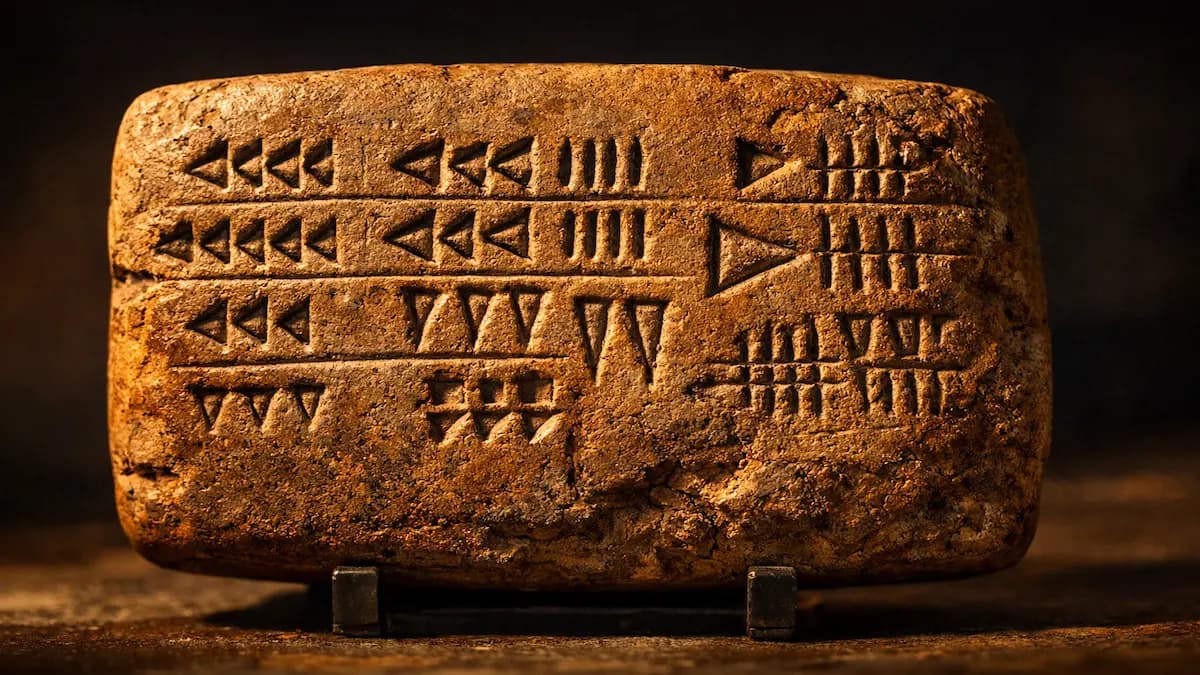
I built the circumference of the city wall, 16,283 cubits, the number of my name.
Sargon II, King of Assyria, ~720 BCE — Khorsabad inscription
Earliest evidence of tallying and astronomical number use in Mesopotamia and Egypt
Sargon II encodes his name as a number in the walls of Dur-Sharrukin
Greek isopsephy emerges alongside the Milesian numeral system
The mathematics of harmony
If there is a single scientific centrepiece to the story of numerology, it is Pythagorean harmonics: the discovery that musical consonance corresponds to simple numerical ratios. A single stretched string divided at 1:2 produces an octave; at 2:3, a fifth; at 3:4, a fourth.
This was among the earliest demonstrations that nature encodes mathematical relationships — and it is genuinely remarkable. The tradition attributes the discovery to Pythagoras and the monochord, a single-string instrument with a movable bridge.
But precision matters here. Pythagoreanism was not just mathematics — it was a movement involving a structured way of life, religious doctrines like metempsychosis (transmigration of the soul), and number mysticism. The Pythagoreans assigned genders and moral qualities to numbers. The mathematical discovery is real; the leap from acoustics to destiny is philosophical, not scientific.

| 1 | 2 | 3 | 4 | 5 | 6 | 7 | 8 | 9 |
|---|---|---|---|---|---|---|---|---|
| A J S | B K T | C L U | D M V | E N W | F O X | G P Y | H Q Z | I R |
What "vibration" actually means in physics
In physics, vibration is periodic motion in a physical medium, measurable as frequency (Hz) and amplitude. Sound is a pressure wave — a disturbance of matter transmitted outward. The Pythagorean insight is that simple frequency ratios sound consonant. Later traditions generalised "number equals harmony" into "number equals cosmic order" — a cultural interpretation, not a physical law.
Modern numerology is a 20th-century invention
The familiar systems — Life Path numbers, personal year cycles, name charts reducing letters to 1–9 — were not handed down from Pythagoras. They were assembled and popularised in the early 1900s, and the word "numerology" in its divinatory sense appeared around 1907–1911.
Early 20th-century numerology is deeply connected to metaphysical movements of the time. Mrs. L. Dow Balliett, one of the most influential early authors, wrote explicitly of "attaining success through the strength of vibration" — a system she framed as taught by Pythagoras. The "vibration" vocabulary in numerology is not modern physics; it is a historical artifact of early-1900s metaphysical culture borrowing scientific-sounding language.
The New Thought movement — a 19th-century American mind-healing tradition based on religious and metaphysical presuppositions — provided the cultural soil. The New Age movement then carried these ideas to mass audiences in the 1970s and 1980s.
- 1907
The word appears
O. Hashnu Hara publishes one of the first texts using "numerology" in its modern sense — a self-help system linking names to numbers.
- 1910s
"Vibration" enters the vocabulary
Mrs. L. Dow Balliett blends Pythagorean references with New Thought metaphysics, framing number analysis as attunement to cosmic vibration.
- 1970s–80s
New Age mass-market repackaging
Numerology reaches mainstream audiences through the New Age movement, often stripped of its historical context and presented as ancient wisdom.
Numbers have power. The power is not over events; it is over the human minds.
Underwood Dudley, mathematician, 1997
Cycles explained mathematically
Some cycles attributed to numerology match real periodicities — not because "the universe runs on 9," but because calendar mathematics and number theory produce genuine patterns.
The Mesoamerican Calendar Round combined a 260-day sacred cycle with a 365-day solar cycle. Because the least common multiple of 260 and 365 is 18,980, the combined pattern repeats every 52 years — a real, calculable periodicity documented by the Mathematical Association of America.
Meanwhile, many modern numerology methods reduce numbers by summing digits until a single digit remains. In mathematics this is the digital root, which is closely tied to arithmetic modulo 9. If your "personal year number" includes the calendar year and uses digit sums, it will naturally repeat in a 9-year rhythm — not because of cosmic significance, but because of how base-10 numbers behave under mod-9 reduction.
Any number's digital root equals its remainder when divided by 9 (with 9 mapping to 9, not 0). This is why numerology's 9-year cycles are mathematical certainties, not mystical discoveries.
Calendar Round
LCM of 260 × 365 = 18,980 days, or ~52 years. A real astronomical periodicity in the Mesoamerican calendar system.
Metonic Cycle
19 solar years ≈ 235 synodic months. Lunar phases recur at the same calendar date. Used in lunisolar calendars since antiquity.
Digital Roots
Digit-sum reduction is modulo 9 in base 10. The 9-year cycle in numerology is a mathematical property, not a discovery about the cosmos.
Names, languages, and design choices
Most numerology systems map letters (orthography) to numbers — not speech sounds (phonology). But the same letter represents different sounds across languages. English spelling is notoriously opaque; Spanish is relatively transparent. A name adapted between languages can change its computed value.
The International Phonetic Alphabet (IPA) offers a language-neutral way to represent the actual sound of a name. This is precisely why well-built systems make their mapping rules explicit and consistent — to ensure reliable, repeatable results regardless of language.
The fact that letter-to-number mappings are deliberate design choices — rather than physical properties of letters — is what makes rigorous, transparent systems possible. A responsible approach documents its choices, applies the same rules for everyone, and explains the reasoning.
A name can produce different numerological values depending on the language and system used. That's why our methodology documents exactly which mapping rules it applies and why — giving you a consistent, understandable framework.
The psychology of self-reflection
Numerological readings can spark genuinely deep personal insight. Cognitive psychology explains why structured frameworks are such effective tools for self-knowledge. The Forer effect (also called the Barnum effect) shows that personalised personality frameworks activate genuine introspection — people engage more deeply with descriptions when they feel crafted specifically for them.
A related phenomenon is apophenia — our innate drive to detect patterns and meaningful connections. This faculty is one of our most powerful cognitive instruments. Numerology gives it a structured channel: instead of searching for patterns at random, you explore them through a coherent system with explicit rules.
Understanding these mechanisms doesn't diminish numerology's value — it clarifies it. Its value is reflective, not predictive. Numbers provide a structured framework for self-examination, and structured self-examination can be genuinely transformative. The power is real; it is a power over interpretation and personal growth.
The Forer Effect
In 1948, psychologist Bertram Forer showed that people readily find personal meaning in structured descriptions — even identical ones given to every student in his class (rated 4.3/5 for accuracy). The reflective process itself has genuine value: a well-crafted personal framework amplifies our natural drive toward self-understanding.
Apophenia
Our innate drive to find meaningful patterns — even in unrelated data. Numerology gives this faculty a structured channel, turning a scattered cognitive tendency into focused, intentional self-examination.
Numbers have power. The power is not over events; it is over the human minds.
Underwood Dudley, mathematician
Frequently asked questions
Is numerology a science?
Numerology is a structured interpretive system rooted in cultural tradition, not an empirical science. However, many of its underlying concepts — digital roots, modular arithmetic, calendar periodicities — are genuinely mathematical. Our approach separates the verifiable mathematics from the interpretive layer, giving you transparency about what is what.
Where does numerology come from?
Number symbolism has ancient roots in Babylonian, Greek, Hebrew, and Mesoamerican cultures. The specific practice called "numerology" — with Life Path numbers, name charts, and personal cycles — was systematised in the early 1900s, particularly through the work of O. Hashnu Hara and Mrs. L. Dow Balliett.
Did Pythagoras invent numerology?
No. Pythagoras (or the Pythagorean school) discovered that musical consonance corresponds to simple numerical ratios — a genuine mathematical insight. Modern numerology systems invoke his name but were created roughly 2,400 years later, in the early 20th century.
What is the Pythagorean system?
The Pythagorean system maps each letter of the Latin alphabet to a number from 1 to 9 (A=1, B=2, … I=9, J=1, and so on). By summing the values of all letters in a name and reducing to a single digit, you derive numbers like the Expression or Soul Urge.
Why do numerology readings feel so accurate?
Cognitive psychology identifies two well-documented tendencies at work: the Forer effect — our readiness to find personal meaning in structured descriptions, even generic ones — and apophenia — our drive to perceive patterns and connections. Knowing these tendencies are in play is not a reason to dismiss numerology; it's a reason to use it deliberately, as a reflective tool rather than a predictive one.
Experience numerology grounded in mathematics
We separate the rigorous patterns from the mystical claims — giving you a system that is transparent, culturally literate, and genuinely useful for self-reflection.